
USHIO participated in MEMS Engineer Forum 2026 (MEF2026) as a Bronze Sponsor. The event brought together leading experts from across the MEMS industry to discuss emerging technologies,market trends, and manufacturing innovations driving the next generation of MEMS devices.
This article highlights several presentations that stood out during the conference and shares key takeaways on where the MEMS industry is headed.
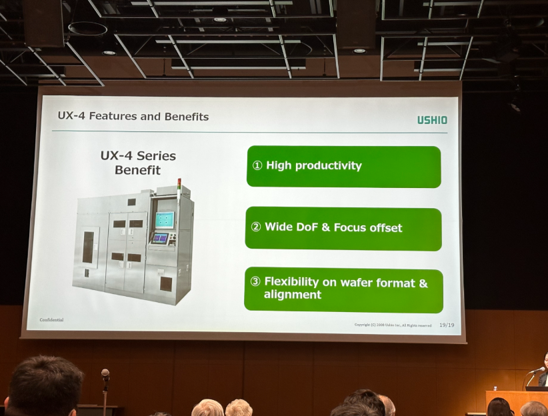
Photo: Presentation at MEMS Engineer Forum 2025.
■ MEF2026 Overview
•Event: MEMS Engineer Forum (MEF) 2026
•Date: April 21–22, 2026
•Location: KFC Hall, Ryogoku, Tokyo, Japan
•Overview: An international technical forum bringing together MEMS researchers, engineers, and industry leaders to discuss the latest advancements in MEMS technology, market trends, and manufacturing innovations
■A New Growth Phase for the MEMS Industry
A central theme throughout MEF2026 was the reacceleration of MEMS market growth. While consumer electronics and automotive applications continue to drive demand, speakers emphasized that future growth will increasingly come from emerging markets such as AI, robotics, data centers, photonics, RF communications, and medical devices.
Beyond new applications, many presentations focused on the technologies required to bring next-generation MEMS devices to market, including:
•Heterogeneous integration of MEMS and silicon photonics
•Advanced sensor architectures and improved device performance
•Manufacturing readiness for volume production
•Packaging, wafer bonding, and process optimization
These topics consistently appeared throughout the conference, underscoring the industry's focus on improving both device performance and manufacturing scalability.
■Presentation Highlights
1.Creating Value Beyond Market Growth
Jerome Mouly, Yole Group
Yole Group presented a positive outlook for the MEMS market, forecasting annual growth of more than 5% following its recovery beginning in 2024.
While consumer electronics and automotive applications remain major growth drivers, future opportunities are expected in robotics, humanoid systems, AI infrastructure, optical switching for data centers, timing devices, and advanced sensing technologies.
2.SiTime: Redefining Timing Technology with MEMS
Paul Hagelin, SiTime
SiTime shared its long-term vision of replacing and expanding traditional quartz timing technology with siliconMEMS devices.
Through innovations in vacuum cavity structures, wafer-level sealing, and the co-design of MEMS devices, integrated circuits, and packaging, the company has achieved improvements in stability and temperature performance.
3.XBAR Technology Enables Next-Generation RF Filters
Patrick Turner, Resonant / Murata
As wireless communication continues to evolve toward higher frequencies and broader bandwidths, RF filter performance requirements are becoming increasingly demanding.
The presentation introduced XBAR technology, which combines MEMS structures with acoustic resonator technology to deliver high-frequency, wide-bandwidth performance.
Advanced FEM-based design techniques, suppression of spurious modes, and optimized device
structures enable high-performance RF filters while supporting scalable manufacturing.
4.Manufacturing Excellence from a Leading MEMS Foundry
Niklas Svedin, Silex Microsystems
Silex Microsystems shared how a pure-play MEMS foundry supports customers through flexible manufacturing platforms designed for a wide range of device architectures.
Because MEMS production often involves high-mix, low-volume manufacturing, precise process control and operational flexibility are essential.
Looking ahead, the company expects continued growth in high-value applications such as medical devices, health monitoring, AR/VR, satellite technologies, AI, and autonomous systems, supported by increasingly sophisticated process control and AI-assisted manufacturing.
5.MEMS and Silicon Photonics: Driving the Next Wave of Integration
Stefan Ernst, X-FAB
The rapid expansion of AI and quantum computing is creating new demands for supporting technologies, including power management, data processing, storage, communications, and optical interfaces.
To address these challenges, heterogeneous integration of MEMS and silicon photonics is becoming increasingly important.
One message resonated throughout the presentation:
"Photonics needs electronics, and electronics needs photonics."
Rather than competing technologies, MEMS, electronics, and photonics are expected to evolve together through deeper integration. X-FAB is supporting this transition by leveraging a common 200 mm manufacturing platform and advanced process technologies.
■Key Takeaways
Across the conference, four major technology trends emerged:
•Heterogeneous integration
•High-precision manufacturing and process control
•Advanced packaging and wafer bonding
•AI-enabled manufacturing optimization
These innovations are expected to accelerate the commercialization of next-generation MEMS technologies across a wide range of industries.
To support these advancements, USHIO provides the UX4, a projection mask aligner designed for MEMS manufacturing that delivers the high-precision patterning required for today's increasingly sophisticated MEMS devices. Through our lithography solutions, we remain committed to supporting our customers from research and development to high-volume production, contributing to the continued advancement of MEMS technology.
For further information,
please contact
Ushio Inc. Corporate
Communication Department
- TEL:+81-3-5657-1017
FAX:+81-3-5657-1020
- contact@ushio.co.jp